
Interactive Physics
Physics Simulation Software for the Classroom
Magnetism
Magnets that attract, repel and turn, a magnetic field that steers moving charges, and electromagnets, motors and generators built from circuits, all part of the simulation.
Interactive Physics adds a magnetic field through the whole workspace, and magnets, since any body can be made one. Their forces and turning effects move bodies like any other force, so magnets work with gravity, springs, pins, slots and collisions in the same model. With circuits, a coil becomes an electromagnet, a current is pushed by the field, and moving magnets and wires make currents.
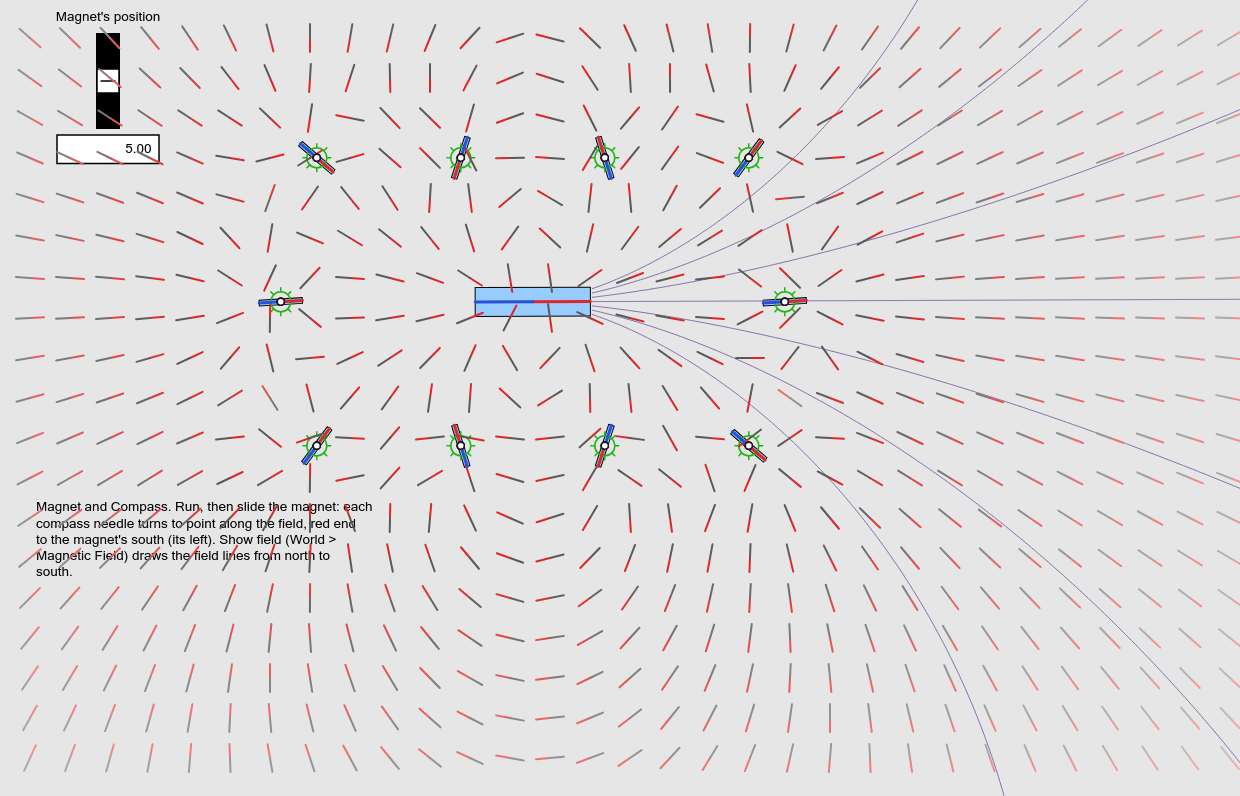
A bar magnet among compass needles. Show field draws the field’s direction and its field lines.
Magnets
Magnetism has its own tools: Bar Magnet, Compass, Coil and Magnetic Field. Students draw a bar magnet and drop compasses straight into a model.
Any body, a magnet
Give a body a magnet strength in its Properties and it becomes a magnet, with its north end in red and its south end in blue.
Attract and repel
North facing south pulls together; north facing north pushes apart. Magnets also turn each other, and the force grows quickly as they close.
Like a compass
In a field across the screen, such as the Earth’s, a magnet turns to line up with it. A compass needle is a small magnet on a pin.
A magnetic field for the whole model
- A field across the screen, such as the Earth’s, turns magnets to line up with it.
- A field into or out of the screen pushes a moving charged body at right angles to its motion, so a charge moving across it travels in a circle of radius r = m v / (q B).
- Show field draws the field on the workspace: a grid of field directions, and field lines from the magnets’ north poles.
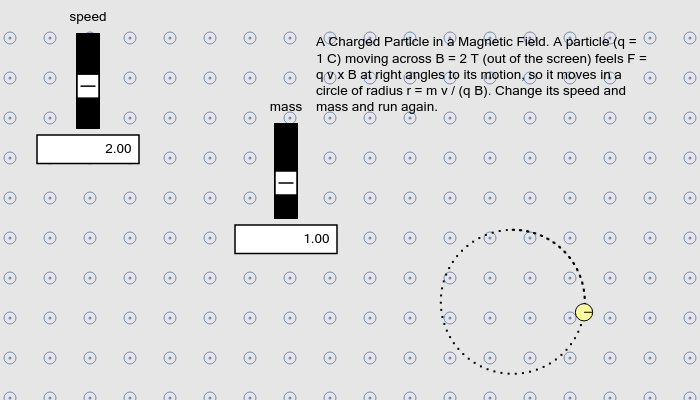
A charged particle circling in a uniform field, with its track drawn.
See it and measure it
Magnets move and turn as the model runs, and the usual meters measure what happens: a body’s position, velocity, rotation, momentum, energy and forces. Time a compass needle’s swing, graph a floating magnet’s height, or turn on Track to draw a charged particle’s path.
Sliders can set a body’s mass or starting speed, so students change a value and run again. Magnetic forces are computed every frame, so runs replay and step back like any other motion.
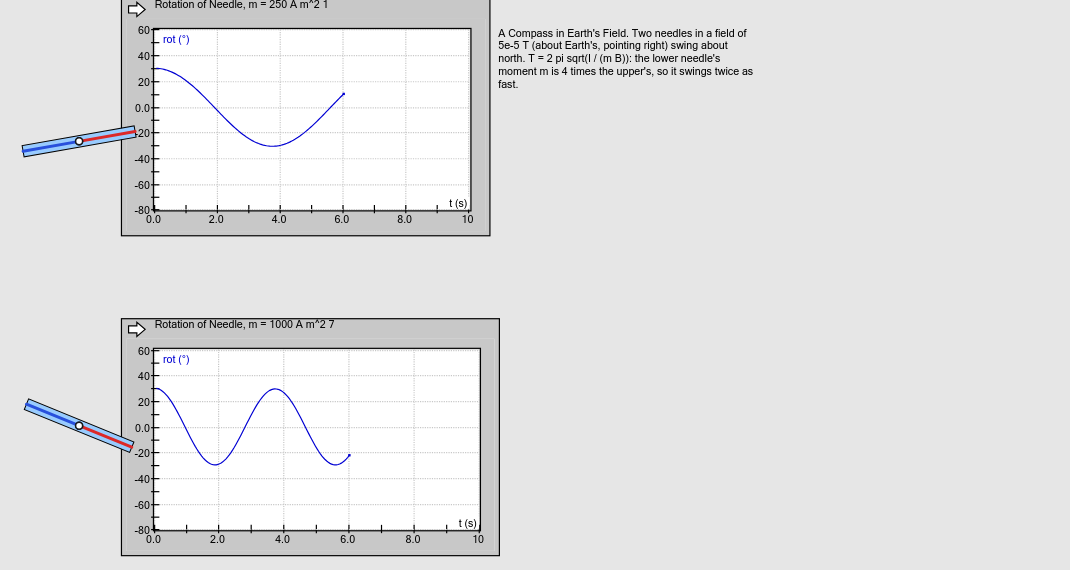
Two compass needles swinging about north, with graphs of their angles.
Magnetism with mechanics and electrostatics
Magnetic forces act together with everything else in the model. A magnet on a vertical slot floats above another where their repulsion balances its weight, and a compass needle on a pin swings and settles.
A charged body feels both the electric forces between charges and the magnetic force of the field, using the same charge property as electrostatics.
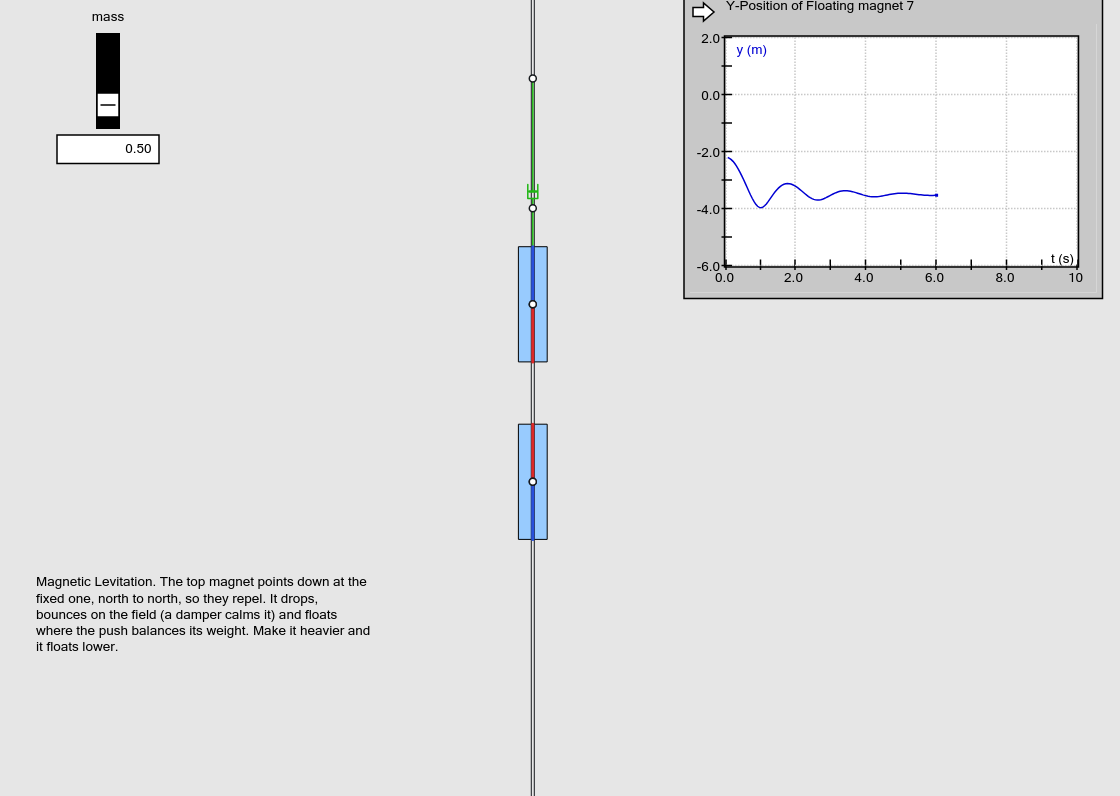
Magnetic levitation: a magnet floats above a fixed one as its height settles.
Electromagnets, motors and induction
Magnetism and circuits work together, and Interactive Physics solves the circuit and the motion together at every step, so currents, forces and magnets keep exactly in step.
Electromagnets
A Coil circuit part attached to a body makes that body a magnet. It pulls and turns other magnets and compass needles, and reversing the battery swaps its poles.
Force on a current
A current-carrying part on a body can be pushed by the field. A rod on rails becomes a motor that speeds up until its back voltage cancels the battery.
Generators
A wire moving through the field makes a voltage: a sliding rod lights a bulb and is braked by the field, and a spinning disc’s spoke drives a current.
Induction
A magnet moving through a coil drives a current, one way as it arrives and the other as it leaves. A coil spinning in a field is an AC generator.
Transformers
Two coils on one core make a transformer, whose voltage follows the turns ratio.
Energy is kept
A coil pushes back on whatever moves it (Lenz’s law), so a generator is harder to turn when it lights a bulb.
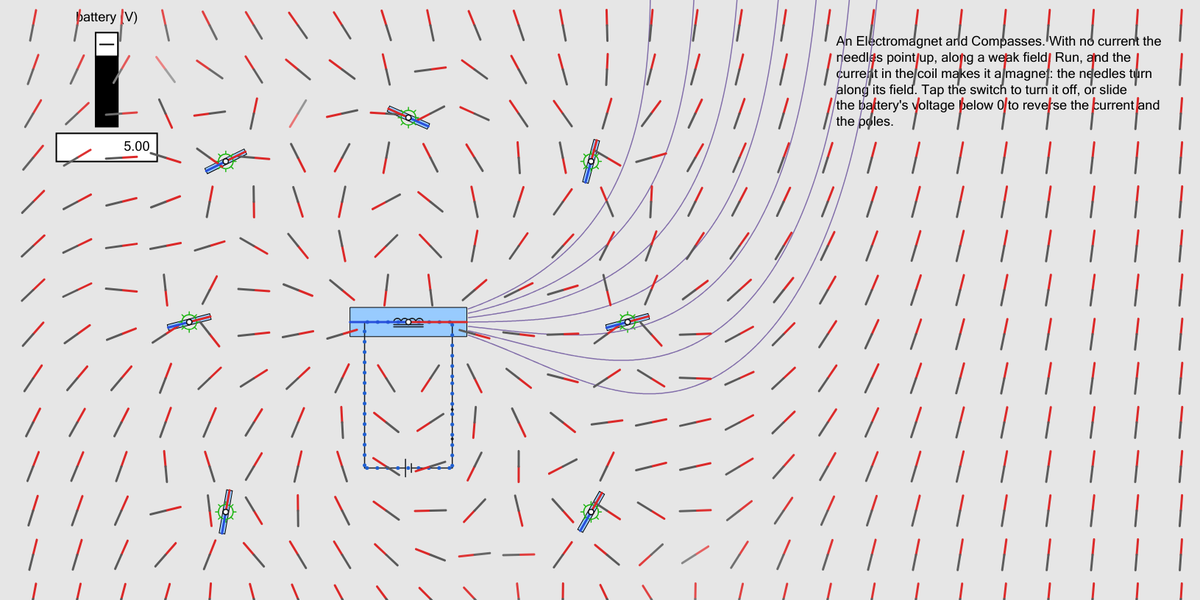
An electromagnet: the coil’s current turns the compass needles, and Show field draws its field.
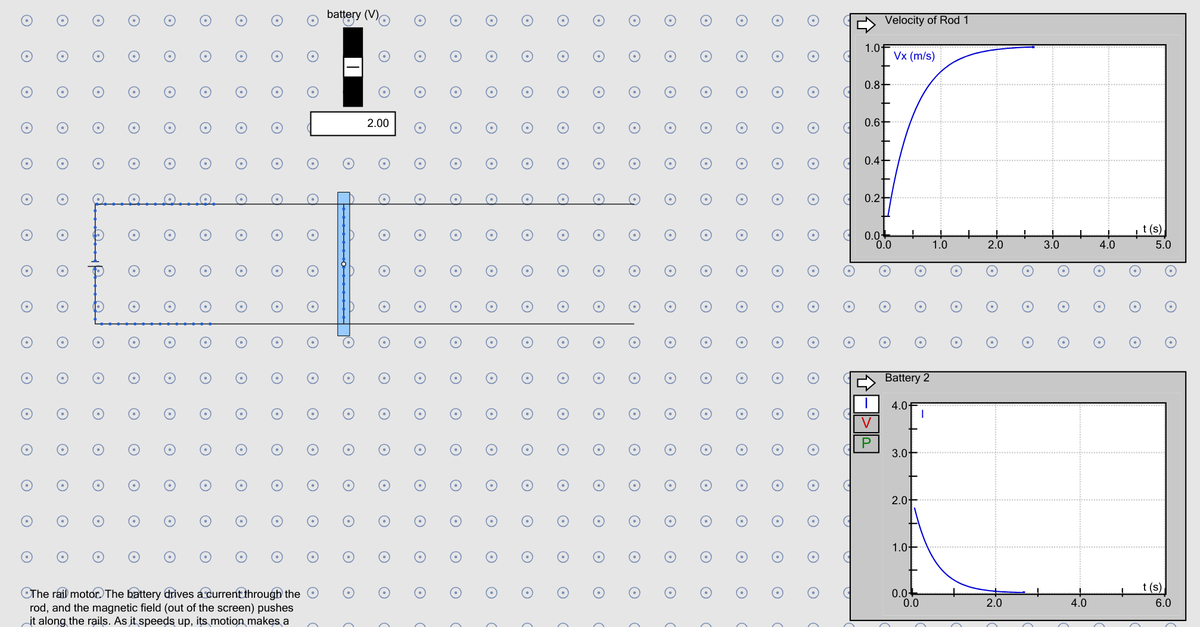
A rail motor: the rod speeds up as its back voltage grows and the current falls.
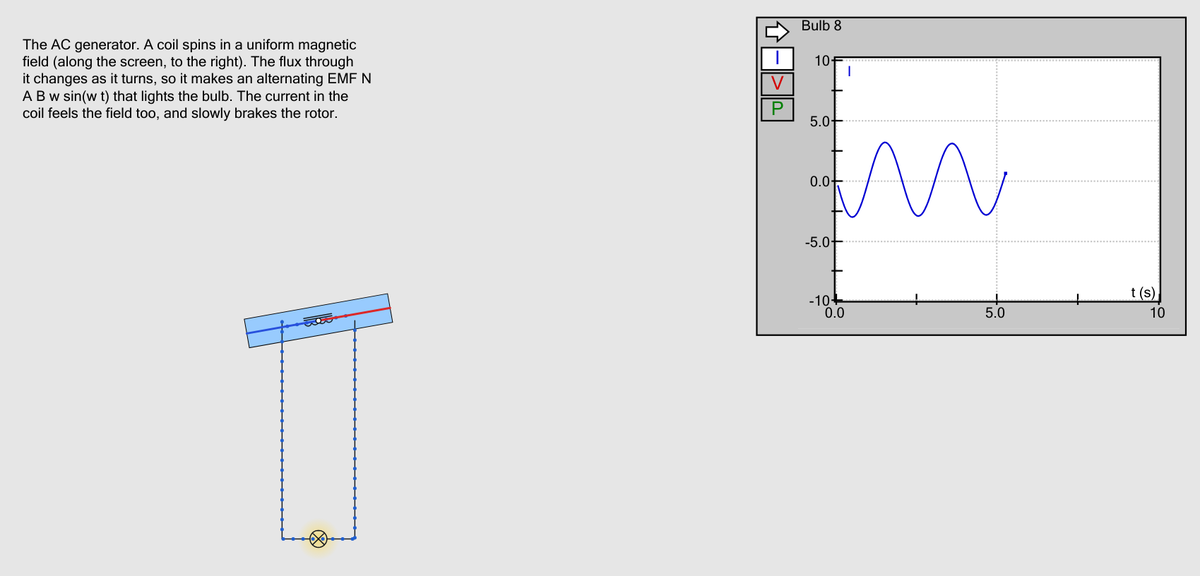
An AC generator: a spinning coil lights a bulb with alternating current.
Ready-made experiments
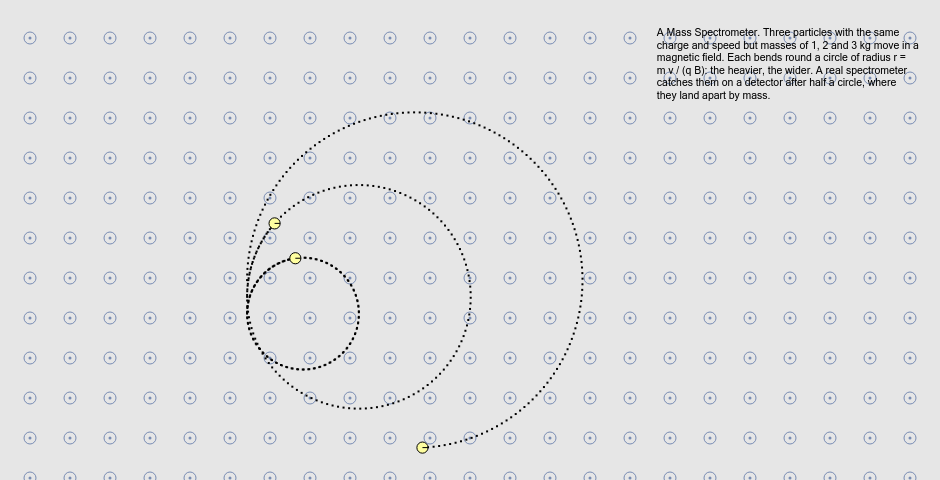
A mass spectrometer: the same charge and speed, different masses, different circles.
The Magnetism topic in the Physics Experiments has 16 ready-made experiments to start from.
Cyclotron Demonstrator
Charged particle spiralling inside a cyclotron
Electromagnetic Induction
Induced EMF from a moving magnet and coil
Electron Deflection
Beam of electrons curving in a magnetic field
Magnetic Deflection
Charged particle deflected by a magnetic field
Magnetic Field
Visualization of a magnetic-field pattern
Oscillating Magnetic Field
Response of charges to a time-varying magnetic field
Compass Near a Magnet
A pivoted compass needle turns to line up with the field of a bar magnet you move
Magnet Through a Coil
A magnet passes through a coil: the flux and the EMF = -N dPhi/dt; faster gives a bigger EMF
Bar Magnet and Compasses New
Slide a bar magnet among compass needles: each turns along the field, and Show field draws the field lines
Attract and Repel New
North facing south, two magnets pull together; north facing north, they push apart (the force grows as 1/r^4)
A Compass in Earth's Field New
A compass needle swings about north with period T = 2 pi sqrt(I / (m B)): a stronger needle swings faster
Magnetic Levitation New
A magnet floats above another where their repulsion balances its weight; make it heavier and it floats lower
Charged Particle in a Magnetic Field New
A charge moves in a circle of radius r = m v / (q B): change its speed and mass with sliders
Mass Spectrometer New
Particles with the same charge and speed but different masses bend round circles of different sizes
Electromagnet New
A coil's current makes it a magnet of strength N I A that pulls a bar magnet; reverse the battery and it pushes
Electromagnet and Compasses New
Compass needles turn along a coil's field when its current flows, and the other way when it reverses
See the Magnetism experiments »
Where to find it
In Interactive Physics for Windows, the ribbon has a Magnetism group with the same four tools: Bar Magnet, Compass, Coil and Magnetic Field. Magnetic Field is also in the Fields group of the Advanced ribbon and the model browser’s Define Fields menu, and any body’s magnet strength is in its Properties.
Try Interactive Physics with your class
Free evaluations are available for teachers and schools.
- Home
- Capabilities
- Mechanics
- Circuits
- Magnetism
- Heat Flow
- Experiments
- Curriculum
- Purchase
- Questions before Purchase
- Find a Reseller
- Reviews
- Product Videos
- Support Videos
 Quote
 Evaluation


